
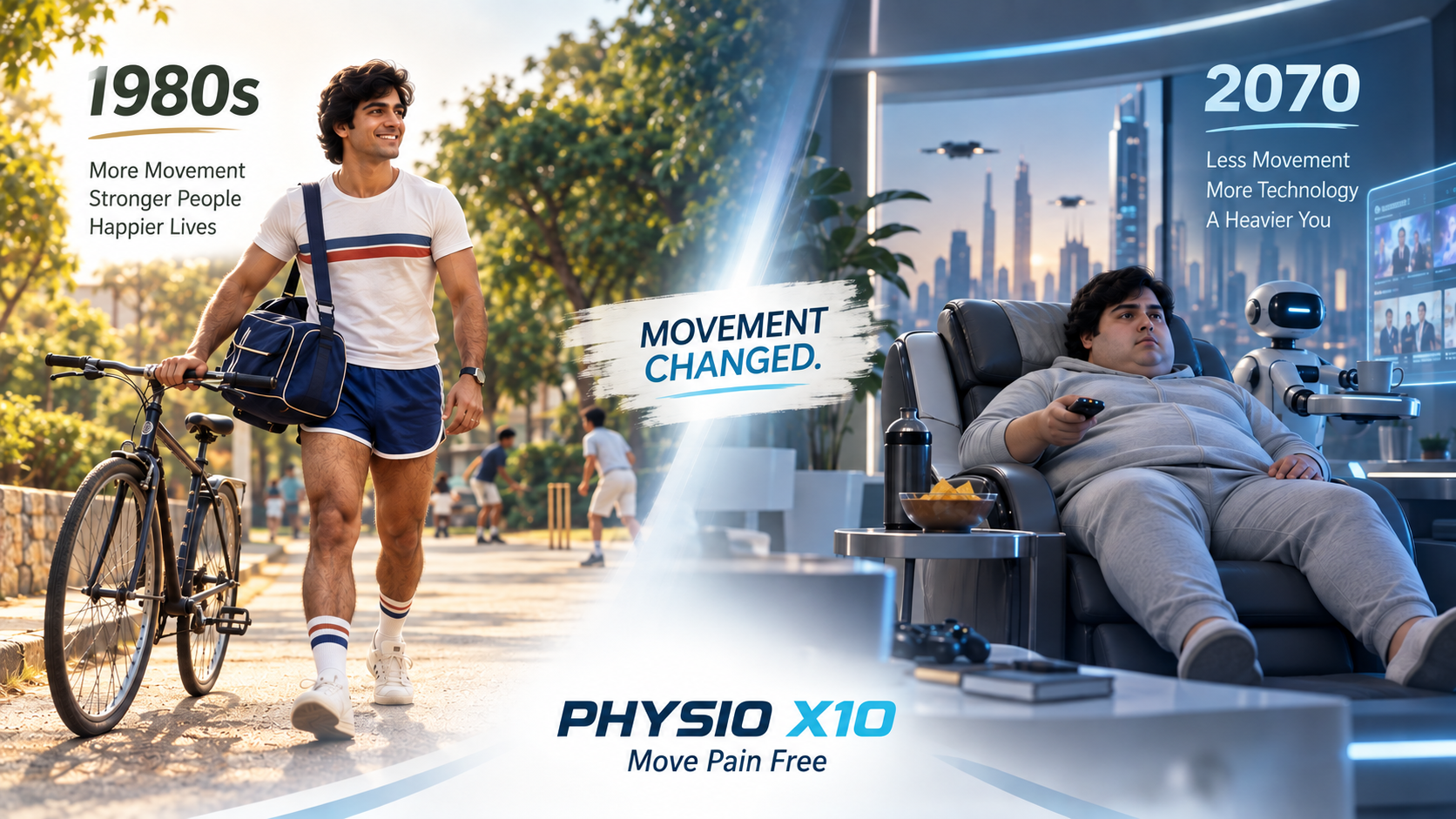
Look at life in the 1980s, life today and imagine life in 2070. The biggest difference may not be the clothes, buildings, cars or technology. It may be something much more fundamental: how much we move.
In the 1980s, movement was naturally built into everyday life. People walked more, cycled, travelled actively, performed household tasks manually and spent more time outdoors. Work itself often required physical effort.
Today, technology has made life faster and more convenient. But convenience has also removed many movements from our daily routine. And if we imagine 2070, automation could remove even more.
The question is not whether technology is good or bad. The real question is: Are we adapting our bodies and our movement habits at the same speed as technology is changing our lives?
The 1980s: Movement Was Part of Life
For many people, physical activity was not something that needed to be scheduled. Walking to places, cycling, climbing stairs, playing outdoors and doing physical household work were simply parts of life.
Exercise existed, but everyday movement itself contributed significantly to physical activity.
The World Health Organization defines physical activity broadly as any bodily movement requiring energy expenditure, including transport, work, household activities, recreation and exercise.
Today: We Sit More, Then Exercise More
Modern life has created an interesting contradiction. We may spend eight to ten hours of sitting at a desk, several more hours looking at a phone or screen, travel by car, order food online and use elevators and then try to compensate with an intense workout. For people who spend long hours at a desk, understanding lower back pain while sitting is an important part of maintaining movement awareness.
This creates two extremes.
One person does almost nothing.
The body becomes progressively less conditioned to movement.
Another person suddenly pushes too hard.
After long periods of inactivity, they begin intense workouts and may overload tissues that are not prepared for that demand.
Appropriate strengthening and conditioning should match the person's current capacity, goals and physical demands.
WHO guidelines emphasize that reducing sedentary behaviour and increasing physical activity are both important for health.
The problem is not simply less exercise. The deeper problem is less movement awareness.
The Spine: The Silent Record of Our Lifestyle
The spine is one of the clearest examples of this changing environment. Our bodies were designed to move through different positions, loads and activities. Modern work, however, often keeps us in the same position for prolonged periods.
Sitting itself is not automatically harmful. The bigger concern is the combination of prolonged sedentary time, insufficient movement, poor conditioning, repetitive workloads and limited awareness of how the body responds.
Back pain has become a major global health problem. WHO reports that low back pain affected approximately 619 million people globally in 2020 and remains the leading cause of disability worldwide. This is why spine health and physiotherapy should not begin only after pain appears. It should begin with understanding movement.
Movement Awareness: The Missing Piece
At PHYSIO X10, we believe movement awareness should begin before movement becomes a problem. Physiotherapy should not only help people recover after an injury. It should also help people understand how they move, why their body may be struggling and how their daily habits influence physical function.
Movement awareness means understanding:
- How you sit and work
- How you stand and walk
- How you lift
- How you exercise
- How much you move during the day
- How your body responds to increasing or decreasing loads
- When your body needs recovery
- When pain or discomfort should not be ignored
This is particularly important for people working long hours at computers, professionals with sedentary jobs, athletes, older adults and anyone experiencing recurring neck, back or joint problems.
A New Problem: Panic Instead of Response
There is another change happening alongside our physical lifestyle: how we respond mentally to our bodies.
We are increasingly exposed to instant information, instant solutions and instant reactions.
When pain appears, some people panic and immediately search for the worst possible explanation. Others ignore the problem completely until it becomes difficult to manage.
Similarly, fitness can become reactive. After months of inactivity, someone may suddenly begin intense exercise because they feel they “need to get fit immediately.” The body may then experience a sudden increase in physical load. The goal should not be “do nothing” or “do everything.”
The goal is to understand what your body needs, when it needs it and why.
Is Your Body Adapting to Your Lifestyle?
Long hours of sitting, recurring pain, reduced movement or sudden changes in exercise can affect how your body responds. Understanding your movement patterns is the first step toward making better physical decisions.
2070: What Happens If Movement Keeps Disappearing?
Imagine a future where artificial intelligence, automation, autonomous transport and smart homes perform most everyday tasks.
Technology may make life extraordinarily convenient. But convenience could also remove more opportunities for natural movement.
The 2070 image is therefore not a prediction. It is a question: If technology does everything for us, will we still know how to move ourselves.
The future of health may depend not only on better technology, but on maintaining the human ability to move, adapt and understand our own bodies.
Technology improves life. But movement keeps you living it.
Make Movement Part of Your Life
Don't wait for pain to tell you that something has changed. Understand your movement, build physical capacity and develop habits that support your body today and into the future.
PHYSIO x10
Move Pain Free